Dr Vino's wine blog
wine talk that goes down easy
The dearth of recommendable California wines under $12
The New York Times magazine ran an charticle on Sunday that compiled the picks of 18 wine industry types. The category? Wines under $12.
But the list raised questions for Ray Isle of Food & Wine, since he tweeted:
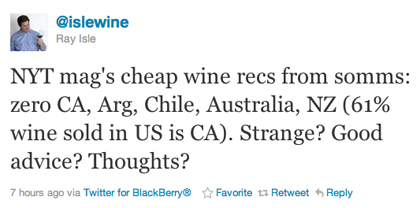
The lack of California wines is understandable for a couple of reasons. Yes, California makes a lot of wine and much of it is under $12. But, as we have discussed before, precious little of the California wine under $12 is estate wine; rather it is often assembled from far-flung vineyards in steel tanks so large they could double as nuclear silos. The two American wines on the list, from NY and OR, are both from single estates.
The people on the list, mostly wine directors at restaurants, don’t exactly champion tanker wine. They are trend-setters or at the very least someone who wants to help a diner or customer discover something new that they might only find at a restaurant or specialty shop. Also, the composite nature of the list means that one author didn’t save spaces for certain categories as each contributor gave a top pick. As to the absence of other new world countries, perhaps that was a function of the taste preferences of the people surveyed too.
Anyway, good wine under $12 is always of interest and Ray raises some good questions. What do you think?
Oct
5
2011
32
Some summer wine picks – and Forbes.com
 Shiraz and Chardonnay account for half of the vineyard acres planted in Australia. For a quick taste of how the other half drinks, check out a piece that I wrote for Forbes.com.
And if you’re feeling summery, surf on over to the James Beard blog for five of my summer wine picks.
But to reward all of you site readers here with some wine picks, I organized and led a fun tasting of seven summery wines last week at a residence on the Upper East Side. I’ll paste the list of wines below for your perusing, from lightest to fullest, with some reactions from the folks in attendance. Incidentally, as I was talking about rosé being the ultimate lunch wine, especially if it was lunch outside under an umbrella, one woman had a funny quip: Who actually has lunches like that? Ah, perhaps we need an impossible wine-place pairing: the office!
Nino Franco, Rustico, Prosecco. $16. very popular
Broadbent selections, Vinho Verde, 2008, $10. sort of popular
Binner, Gewurztraminer, 2005. $25. I liked it a lot, they didn’t (probably too rich for a warm evening)
Bernard Baudry, rosé, Chinon, 2008. $17 popular
Marcel Lapierre, Morgon, 2007. $24. A delicious wine, unanimously loved
Rossignol-Trapet, Bourgogne rouge, 2006. $23 very popular
Les Hérétiques, vin de pays de l’Hérault, 2007. $8 very popular
Jun
19
2009
Fred Franzia and American wine under $10
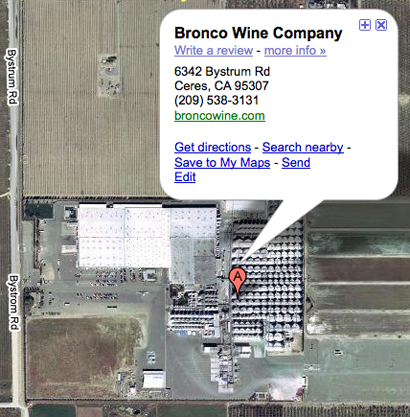
Fred Franzia, creator of Two Buck Chuck and founder of Bronco Wine Co, has a somewhat laudable if self-serving goal: no wine should sell for over ten dollars a bottle. While tasty wine under $10 is something wine consumers could rally behind even in the best of times, the recession certainly makes value have greater appeal now. The only trouble with Franzia’s wine is the that they just aren’t that tasty.
The current issue of the New Yorker has a lengthy profile of Franzia that is well worth reading, especially if you’re not familiar with his story. Here’s how the author describes his winery in Ceres, California:
It also irritates Franzia when people describe Bronco’s facility, with its four hundred and fifty-two stainless-steel storage tanks–including six liquid oxygen tanks that once held fuel for intercontinental ballistic missiles and are now being used to make champagne [sic]–as being reminiscent of an oil refinery.
(In addition to the satellite image above, click here for a street view of the flags. Franzia had this to say about the flags in the story: “No California flag–they’ve screwed us too many times. We shouldn’t fly the US flag, the bastards. They have a felony on us.”)
One of the biggest puzzles about the American wine market is why there are so few tasty values made in the USA. Imports, somewhat paradoxically, offer better value despite traveling a farther distance and often having to pass through another tier, the American importer.
What do you think are the key reasons that American wines under $10 are so often uninspiring? (Granted, there certainly are uninspiring imports under $10 but there are also some rustic wonders that sell for three to six euros in Europe.) Here are some variables to toy with: short-ish history of American wine with relatively few small growers, recent industry consolidation, the soil and/or climate, high land prices, producer greed/pride, the three tier distribution system, or the consumer as chump.
Swirl. Spit. Discuss. And while you’re at it, let us know your favorite American wines under $10–or even cast the net wider to include wines under $15 if under $10 is too hard. Maybe in a future post we’ll do a low-cost throwdown, domestic versus imports.
May
13
2009
Bigger is better: Gru Vee in one liter
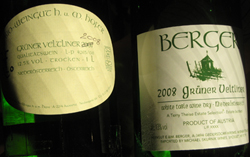 We all know bigger is better. No, not that way; get your mind out of the gutter. When it comes to wine, the reason is at least twofold. First, a bigger bottle has a lower carbon footprint per ounce of wine because there’s a more favorable wine to packaging ratio. Second, more wine!
I’m not sure how important the first of these two reasons is for wine consumers but the second is one of those things that everybody can agree is a good thing.
And so they have. Jonathan Schwartz, the hirsute portfolio manager of Terry Theise wines for distributor Michael Skurnik, says that sales of his five one-liter Gruner Veltliners from Austria have been zooming. “Restaurants like them because it’s an extra glass and a half per bottle for wine-by-the-glass pours. Wine shop customers like them because it’s a glass and a half more wine.” (A standard bottle has 750 ml.)
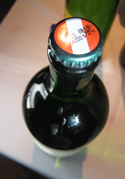 He said that people are interested in the closure too, which on the Hofer and the Berger, the two best selling of the wines, is a crown cap (think: beer).
So which is better? I tasted them at the Skurnik tasting today. Both are simple versions of Gruner Veltliner, clean and zesty with a minerally verve. The 08 Berger (about $11; find the 2007 or the 2008) is slightly softer and the 08 Hofer slightly more tart (about $11; find the 2007 or the 2008). The wines are both an easy extension for people who love pinot grigio but are looking for something new. Hofer is made biodynamically, which goes to show that biodynamics and low price are not antithetical to each other. Berger is practicing organic. Gru Vee.
Jan
20
2009
Three French reds under $10: Montirius, Heretiques, Fenouillet
Everybody always wants a good wine under $10. And that’s never been more true than now. The sad thing is that it’s so hard to find good wines under $10. But here are three reds from the South of France!
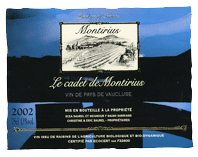 Montirius, Le Cadet, vin de pays de Vaucluse, 2005 ($9.99; find this wine)
This blend of 50% Grenache – 30% Syrah – 20% Cinsault comes from a couple in the Southern Rhone who make their wines biodynamically. This particular cuvee is fermented in cement (!) tanks. When I met Christine and Eric Saurel, the owners and winemakers, a few years ago at a trade show, they told me that cement is more “alive” than stainless steel but doesn’t impart the flavors of oak. It is a great value with good acidity, fun dark berry notes, and tannic poise. I need to restock, probably by the case.
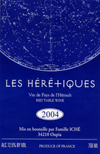 Les Hérétiques, vin de pays de l’Hérault, 2007 ($9; find this wine)
Made from Carginan grapes, this wine hails from the Languedoc region. It has a whiff of that bretty barnyard thing, which some might find off-putting and others alluring. But on the palate there’s not much to argue with since the wine has good fruit and tannins. It’s not as smooth or rewarding as the Chateau d’Oupia, from the same producer, but this one would make a solid party wine. Importer: Louis/Dressner.
Domaine de Fenouillet, vin de pays de Vaucluse, 2007. ($9; find this wine)
Marcelan? Yeah, I hadn’t had that one either. But it’s the main grape in this wine, also from the Vaucluse like the Montirius. The wine is a little less structured more tannic than the other two so I would use this wine as “ballast,” i.e. when there are four of you and two bottles are already empty and you need to crack open a third bottle of something decent that’s not too expensive. Importer: Neal Rosenthal.
Jan
16
2009
The best box wines of 2008
“Merry Christmas!” I said to my aunt as she greeted us at the door for our annual wintry get together with my cousins. “Here’s 24 liters of wine!” Although I had told her that I would bring the wine, I hadn’t mentioned that it was eight three-liter boxes of wine. Season’s greetings!
So my relatives were the latest involuntary recruits in my effort to find the best box wines of 2008. You might think that the best box wine is kind of like being the tallest resident in Gulliver’s Lilliput. And you’d mostly be right. But since I called for more wine to be put in box format for economic and environmental reasons earlier this year, I thought that I owed it to you to do a quick survey of the landscape. I still think they make sense economically since they pack in the same amount as four regular bottles and mostly sell for around $20 (although the most expensive one I tried was $40).
What I like best about the packaging is the ability to squeeze off a glass a night for an extended period of time, thirty days or more according to the producers.
Standing tall
 1. Yellow + Blue Malbec, Mendoza, Argentina (about $11 for one liter; find this wine)
This organically grown red from Argentina sees no oak, is shipped to North America in a tanker where it is packaged into a Tetra Pak–think juice boxes for adults. I’ve poured this wine, introduced for the first time in 2008, many times to groups this year, often blind and from a decanter, and it has been almost universally praised. And when I tell them it’s the equivalent of $8 a bottle, they usually wonder where they can get a case.
2. “From the tank,” Estezargues, 2007. Cotes du Rhone (about $40; find this wine)
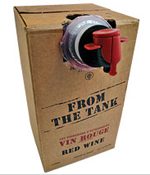 This big blend of grenache, syrah and carignan, has that ripe, juicy quality from many of the wines of the region. New to the US market this year, it’s organically grown and has a complexity that you really wouldn’t expect from a three liter, bag-in-box format. One word of caution: I found that this wine depreciated a week after opening so it may be best at parties, rather than nursing it over a whole month.
The best of Lilliput
Underdog Wine Merchants is a relatively new unit of The Wine Group, a boring sounding company that is actually the third largest producer of wine in America. They know a thing about box wine too since they make the dreaded Franzia, which has stigmatized the box format almost single handedly. But with Underdog, they are generally cranking quality up a notch, appealing to specific demographics with various brands, which can more often than not, seem to be trying a bit too hard with cutesy names or text on the packaging.
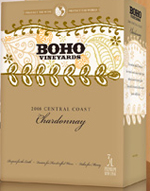 The best of their offerings, in my view, are the BOHO Cabernet Sauvignon and Chardonnay (about $20 for 3L; find this wine). You won’t mistake the Cab for a St. Estephe in a blind tasting but it seems to have something approaching on structure, without excessive flab that many super-low-priced Cali Cabs have from oak chips. The Chardonnay is also restrained in it’s oak effect, a good thing in my view.
Honorable mention
Darling Hills, Ovation, South Africa (about $20 for 3L; find this wine): a 50-50 blend of Cabernet Sauvignon and Cinsault, the workhorse grape originally from the South of France. It has a smoky note–think chipotle–that some that I served this absolutely adored, others hated. One thing’s for certain: the wine changed for the worst after only a couple of weeks of being open, so drink up.
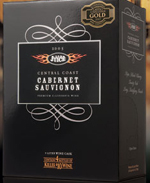 Killer Juice (about $20 for 3L; find this wine): Another wine from Underdog, this wine is packaged with a Harley aesthetic and the dramatic proclamations about the “killer” quality. While I found it a little two brawny and low in acidity, it was a favorite at my aunt’s house as my cousins kept squeezing off pours from this one. A crowd pleaser.
I look forward to reviewing box wines again in 2009. Three liter box wines have been a strong growth segment for the past few years and consumer attitude, as least on this site, are ready. So I’m raising a glass in the hope that more producers will continue to see better wines in this format.
Dec
26
2008
Wine goes nuts: Manzanilla sherry and marcona almonds
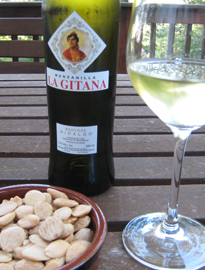 One of my private tasting clients asked me an unusual question recently: which wine goes with almonds?
The answer was easy: sherry. A much misunderstood wine, it’s not just for sherry hour in the faculty lounge any more–it is distinctive and makes a great aperitif. And probably because of the confusion, it’s also a great deal.
In order to try this out, I bought the Hidalgo La Gitana ($10; find this sherry) and got some marcona almonds. On it’s own, chilled, the sherry is tangy and briney, refreshing and appetizing. But with the marcona almonds from Spain, the whole experience was elevated in one of those classic food-wine pairings that brings out the best in both.
And a little sherry goes a long way; we were able to have three evenings of aperitifs from the same $10 bottle. It may be the ultimate wine for an economic downturn. Pity the almonds were $16.99 a pound.
For more background on sherry, check out Eric Asimov’s recent article in the NYT.
Sep
19
2008
Red, white, and recession: two bargains under $10
You don’t have to have been long financials for most of 2008 to want a good bargain; great wines under $10 are always in demand, and increasingly hard to find. Here are two for weathering the financial downturn–and beating the summer heat.
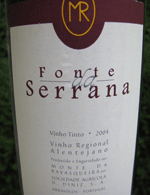 Fonte da Serrana, Alentejo, Portugal, 2004. $5.99 (find this wine)
Alentejo is a hot, dry part of Southern Portugal that, when it comes to wine, traditionally has been more known for making closures–corks–rather than what goes in the bottle. But this wine will make them consider planting more vines. The alluring nose of dried herbs precedes the all-berry attack the attack, which, in turn, is followed by a surprising degree of bright acidity and gentle tannins. A GREAT summer quaffer. And our new house burrito wine. Day two it was still going strong and poured at fridge temp, marvelously refreshing on the deck. The blend is mostly Aragonez (a.k.a Tempranillo) and the indigenous Trincadeira.
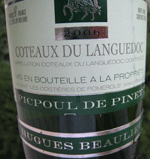 Hugues Beaulieu, Picpoul de Pinet, Coteaux de Languedoc, 2006. $7.37 (find this wine)
Picpoul de Pinet is a blast of summer freshness that comes from a stone’s throw away from the Mediterranean. With a citrus zip of tart acidity, a light saline quality, this wine, from a cooperative producer, is refreshing to pair with 95 degrees–as an aperitif or with seafood. It’s easy to understand why Picpoul is known as the Muscadet of the south both for flavor profile as well as wallet-friendliness. I got this bottle from a sale that is now, sadly, over (bringing the price up to $8.99) but I will definitely get more for the dog days of summer.
Jul
18
2008

Wine Maps
Monthly Archives
Blogroll
Categories
- American wine
- announcements
- Argentine wine
- auctions
- Australian wine
- Beer
- best wines
- Bling
- books
- Bordeaux
- bottled water
- Box wine
- Burgundy
- business of wine
- Celebrity wine
- Champagne
- Chicago
- China
- cocktails
- cognac
- corks
- corkscrews
- dining
- eco wine
- events
- foie gras
- food and wine
- French wine
- German wine
- giveaway
- grapes
- green wine
- guest post
- highlights
- how to
- Italian wine
- leaders and liters
- Mature wine
- meetups
- New York City
- On notice!
- photo captions
- podcasts
- Polls
- Port
- Portuguese wine
- power list
- reader mail
- rose
- sake
- Sommeliers
- South Africa
- Spanish wine
- spirits
- tasting sized pours
- The real wine world
- TV and movies
- Uncategorized
- videos
- vinexpo
- Weather
- wine and health
- wine and sports
- wine and tech
- Wine Blogging Wednesday
- wine blogs
- wine classes
- wine collecting
- wine gifts
- wine in india
- wine labels
- wine picks
- wine politics
- wine quizzes
- wine random
- wine science
- wine scores
- wine shops
- wine technology
- wine travel
- Wine under $10
- wine writing
- winemaking
- winespeak
 Blog posts via email
@drvino on Instagram
@drvino on Twitter
Advertise

quotes
One of the “fresh voices taking wine journalism in new and important directions.” -World of Fine Wine
“His reporting over the past six months has had seismic consequences, which is a hell of an accomplishment for a blog.” -Forbes.com
"News of such activities, reported last month on a wine blog called Dr. Vino, have captivated wine enthusiasts and triggered a fierce online debate…" The Wall Street Journal
"...well-written, well-researched, calm and, dare we use the word, sober." -Dorothy Gaiter & John Brecher, WSJ

Saveur, best drinks blog, finalist 2012.
One of the "seven best wine blogs." Food & Wine,
One of the three best wine blogs, Fast Company
Books for wine geeks

Wine books on Amazon: