Dr Vino's wine blog
wine talk that goes down easy
Bling update: $220k Hennessey Cognac, $50k whisky, $10k Dom
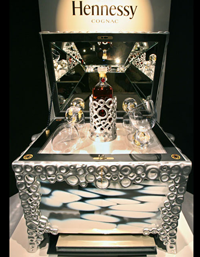 Tis the season for one thing: bling!
Item 1: Hennessey has launched Beauté du Siècle, a limited release cognac for $150,000 euros ($220,000; find this cognac). A blend of 100 year old cognacs yadda yadda, it comes in a Baccarat crystal bottle (of course!) and a display chest that “was made by 10 different artists using mirrored glass and melted aluminum” according to Decanter. A member of the Hennessey board will deliver it personally to whoever buys it–in a stretch Hummer, I’m sure! Any bets on which city will see the first delivery? I’m going with Moscow.
Item 2: A bottle of whisky fetched $54,000 (including commissions) at auction in NYC. One of forty bottles, this 1926 Macallan was housed in a humble wood box. Half the bids came in from overseas.
Item 3: It pays to shop around for bling! A reader writes to say that Sherry Lehmann has a Methuselah (6L) of Dom Perignon 1995 for $9,999 instead of the previously discussed jerobaum (3L) for $17,000 at Crush . Only drawback: it doesn’t have the white gold bling since “This rare bottle is packaged in its own locked case with a metallic finish to preserve and protect this fine wine.”
Item 4: bonus bling for 2008! As tucked away in a quick mention here, the new, 250-case 1995 Krug Clos d’Ambonnay (find this champagne) will be coming out for $3,000+ a bottle.
Related: “Judge this cognac by its bottle“
Dec
18
2007
3
Meet the masters
Cellar masters in cognac comprise a small, elite, de facto club of men–but they don’t wear smoking jackets as you can see below. The top four producers make 84 percent of the volume of cognac and there are only a few dozen smaller producers. Here are the cellar masters I met on my recent trip.
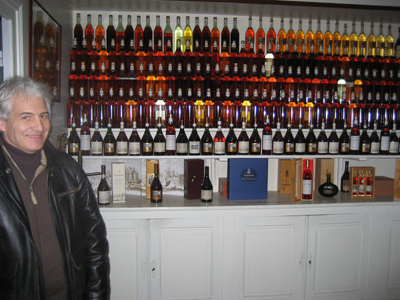
Cellar master: Dominique Touteau
House: Delamain
Tenure: 27 years
House specialty: aged cognacs, some vintage
Highest priced cognac he makes: $500 Reserve de la famille (search for it)
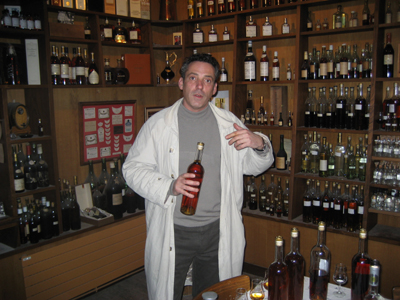
Cellar master: Olivier Paultes
Estate: Chateau Frapin
Tenure: 20 years
House specialty: Owns 542 acres of vineyards; uses exclusively own fruit, stills and cellars
Highest priced cognac he makes: $5,000 for the 1888 from their “paradise” (search for it)
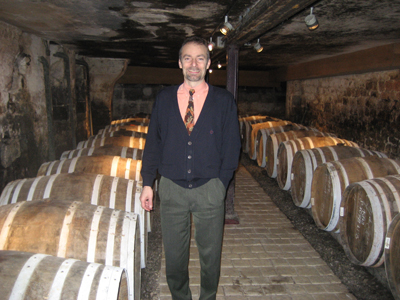
Cellar master: Eric Forget
House: Hine
Tenure: eight years
House specialty: only old cognacs, extensive vintage program, some aged in Bristol
Highest priced cognac he makes: Hine, Talent de Tomas, $6500 sold in wood box and customized Baccarat crystal decanter (search for it)
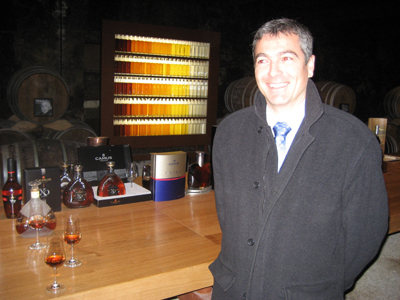
Cellar master: Patrick Leger
House: Camus
Tenure: 4 months
House specialty: This, the fifth biggest house, has some young cognacs from the Ile de Re, other old cognacs
The most expensive cognac he makes: $800 Camus Jubilee (search for it)
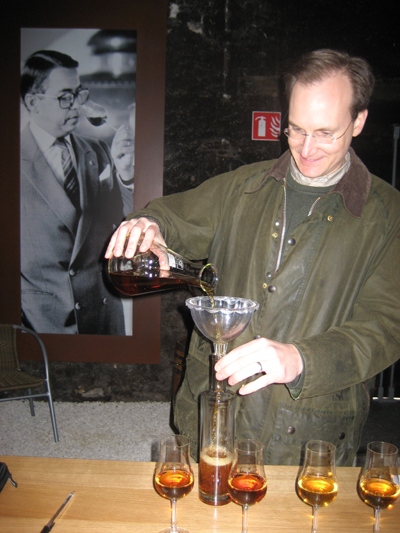
Celler master (impersonator): Dr. Vino
House: visiting at Camus where I tapped some old barrels and started blending
Tenure: 5 minutes
Specialty: sipping cognac
Highest priced cognac he makes: priceless
Feb
12
2007
Judge this cognac by its bottle
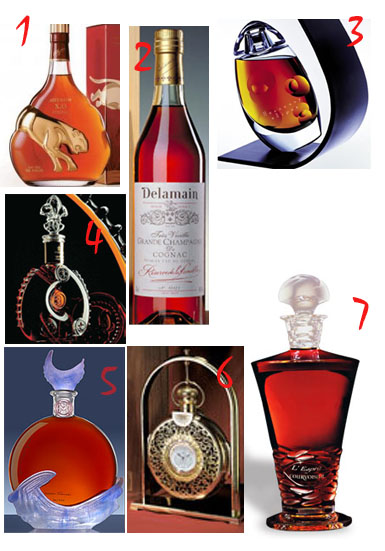 Cognac bottles come in all shapes and sizes. In fact the relatively new Cognac Museum has a whole room dedicated to their historical evolution. Some look like wine bottles while others look more like perfume bottles.
In this assortment of bottles, which one do you think is the most expensive? And the least expensive? And how about your faves? Have your say in the comments!
In a future post, I’ll tell you what’s what–and how much.
 tags: cognac | bottle design
Feb
6
2007
Mummifying cognac in demi-johns
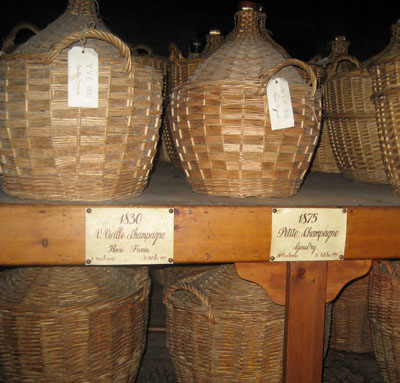
Perhaps you’ve read about–or even tried–cognacs that are over a century old. But given that it can’t last more than 55 years in the oak barrel, what’s the next step?
Demi-johns. These large glass containers, shrouded in wicker or burlap to keep out the light, protect the cognac after the transformative magic of the oak barrel. As Dominique Touteau, cellar master at Delamain, put it to me, the cognac is “mummified” in the bottle. Unlike wine, there’s no such thing as bottle aging in Cognac. It simply maintains the properties acquired from the barrel, the vintage and the growing area. Even though the cellar for the demi-johns is airless and timeless, its not really a tomb as much as it is a preservation chamber. Cryogenics, if you will. They are often stored in an inner-sanctum known as the “paradis,” translated as paradise or Heaven. The term sets the bar high, but then again, these old cognacs can be ethereal.
The demi-johns, or Dames-Jeannes as they are known in French, are stored tightly sealed, upright and out of the light. Every ten years they are given a new cork.
When the cellar master deems it the right time, small amounts of the cognac in demi-johns can be added to the finest blends. I saw one at Martell that was supposedly from 1830, which is mind-blowing to think of the history it’s seen–or not since it has been hidden in a dark cellar.
Stay tuned to find out my tasting notes from the oldest cognac I tasted on my trip! (Bonus points for anyone who can guess the vintage in advance)
Feb
5
2007
Cognac in the barrel and in the cellar
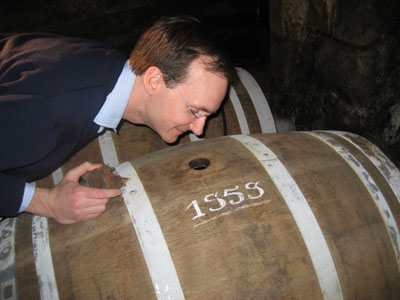
Wine, how young it is. Although winemakers follow different protocols, two years is generally a safe bet for how long wine stays in a barrel. For cognac, that’s just warming up.
Since cognac hits the barrel out of the alembic somewhere between 65 – 72 percent alcohol, it can withstand the tannins of oak longer. Much longer. Although each cognac house follows different norms, the official rules on barrel aging different grades are:
VS = a blend with at least two years in the barrel
VSOP = a blend with at least four years in the barrel
XO = a blend with at least six years in the barrel
Beyond that, it’s up to the individual producers. Many age portions of their XO for more than three times as long as the minimum. And almost all have something older (and more expensive) than XO calling it “extra” or some sort of proprietary name.
The wood for the barrels can only come from France according to law. The two main sources of the oak are the Limousin and Troncais forests, each with its own character. Oak from the Limousin is wider grain, which gives more “woody” character to the resulting cognac. The barrels are also larger than wine barrels often rolling in at 350 liters versus 225L for wine.
Cognac hits its peak in the barrel at about 55 years. After that, the consensus among cellar masters that I spoke with was that it starts to decline in quality.
Each year some of the alcohol and some of the water in the barrel evaporate in a euphemism that is delightfully known as the “angels’ share.” Wine, in barrels, also evaporates. But because cognac is such a higher alcoholic strength than wine, I’d venture to say the angels in cognac cellars are a lot happier. And with a loss of something like 2.5 percent a year to vapors, that’s the equivalent of about 3 million bottles of cognac. The accountants in the region must not like to think about that kind of money literally going up in fumes.
The angels have to compete with another life form: a black mold known locally as “mushrooms” that permeates all of the cellars. Driving around the town of Cognac and the region, it is easy to pick out the buildings that are (or were) cellars since the inescapable black mold, which thrives on the alcohol vapors, clings to the high walls and roofs. One cellar master told me that the Nazis even used aerial photography during the War to identify the cognac cellars from above.
Most of the cellars in the region are semi-permeable membranes to the outside world. Some cellars that I went in had windows, others had cracks to the outside. As a result, the temperatures inside the cellars often reflect the outside, although in a less extreme way (more on how this affects taste soon). When I was there last week, temperatures were around freezing but the cellars were about 45 degrees. In the summer, they can even go higher than 70. Local cellar conditions can vary as some underground storage areas have less temperature fluctuation and higher humidity. But the angels are happy whatever the conditions.
Stay tuned for the next step in aging the oldest and rarest cognacs.
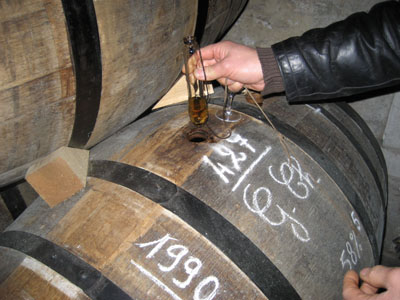 Related: “Barrel sample, cognac style”
tags: cognac | barrel aging
Feb
1
2007
The colors of Cognac
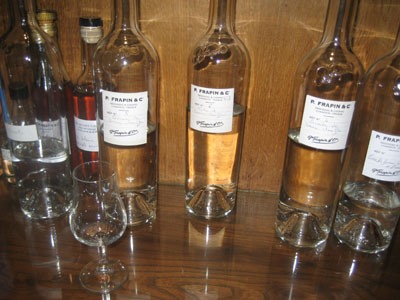
When a distilled spirit is 70 percent alcohol, can you taste the difference? In Cognac, the answer is yes. The cellar master receives the samples of the distillate and smells them for their aromatic qualities. I did it and it was, well, mostly alcohol. But then he adds water to the raw spirit, which, surprisingly to me, greatly amplifies the aromas. Suddenly there were many more aromas and it was possible to distinguish between two distillations from different vineyard sites. In the photo above, distillations from different areas are on the tasting table at Frapin.
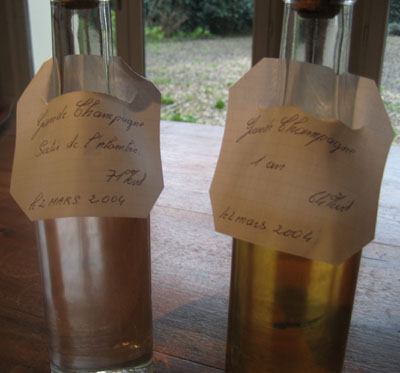
All the spirits are clear immediately after distillation–it’s only the oak aging that adds the enticing golden hue. The photo above shows the distillate fresh out of the alembic and, on the right, after one year of aging in an oak barrel.
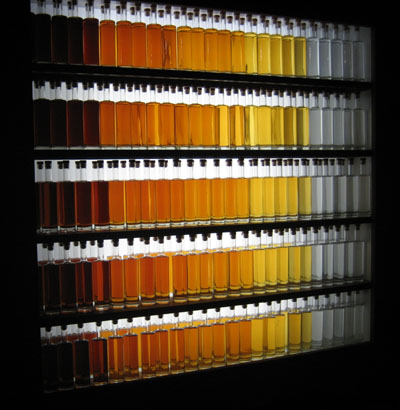
The longer in the barrel, the richer and darker the colors become. The Cognac house Camus has a beautiful demonstration of the progression on display. The just-distilled spirits are on the right moving all the way to fifty-year-old samples from oak casks the left.
tags: cognac | barrel aging
Jan
28
2007
Comments Off on The colors of Cognac
Barrel sample, cognac style
Domique Touteau, cellar master at Delamain, draws a sample from a 1967 barrel of Cognac. Instead of a pipette, more common in the wine world, he uses a “prouvette.” The prouvette is a glass vial tied to a string that he drops in the barrel. If you listen you can hear the bubbles as it fills up. Unfortunately the only light we had in the cellar was one light bulb. Even thought the video is dark, you can still see the golden color in the glass. And the chalk markings on the outside of the barrel indicate its origin, harvest date and the alcohol strength. No barcodes here…
tags: cognac | barrel sample
Jan
25
2007
Cognac word of the day: alembic
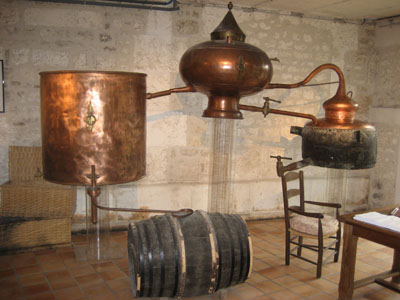
The word of the day from my Cognac trip is: alembic. It’s the distinctive still that the wine must pass through–twice–to become the eau-de-vie that is cognac.
Known in French as the alambic charentais, it is made out of copper, which gives the distillate a distinctive flavor. The wine, a thin acidic wine almost entirely from the ugni blanc grape, goes into the boiler on the right in this miniature, antique example. The vapors, mostly alcohol, rise into the onion-shaped dome on top of the boiler. The lightest ones escape down the bent pipe called the “swan’s neck” and into the cooling tower on the far left. (The thing in the middle simply captures any warm wine to return to the boiler as a measure of economy.) The cooling tank can have a copper coil 60 meters long running through cool water in order to bring the vapors back down to liquid form.
When the distillate comes out of the cooling tower it goes into a cask and then is passed through the still again for the double distillation that makes cognac different (armagnac, for example, gets one distillation usually while vodka can go through the still eight times). The liquid coming out at the end of the second distillation is clear and about 70 percent alcohol. It takes about 9 liters of wine to make one liter of the distilled spirit at the end.
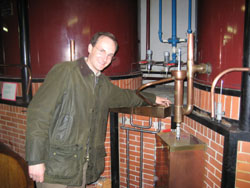 I visited a distillery, which runs 24 hours a day this time of year. All the distillation has to be completed by March 31. The stills can only be 2500 liters for the second distillation, or “la bonne chauffe,” and it takes 12 hours for the process to be completed. Surprisingly, you really can taste a difference in the distillates, potent as they may be.
tags: cognac | alembic | distillation
Jan
24
2007

Wine Maps
Monthly Archives
Blogroll
Categories
- American wine
- announcements
- Argentine wine
- auctions
- Australian wine
- Beer
- best wines
- Bling
- books
- Bordeaux
- bottled water
- Box wine
- Burgundy
- business of wine
- Celebrity wine
- Champagne
- Chicago
- China
- cocktails
- cognac
- corks
- corkscrews
- dining
- eco wine
- events
- foie gras
- food and wine
- French wine
- German wine
- giveaway
- grapes
- green wine
- guest post
- highlights
- how to
- Italian wine
- leaders and liters
- Mature wine
- meetups
- New York City
- On notice!
- photo captions
- podcasts
- Polls
- Port
- Portuguese wine
- power list
- reader mail
- rose
- sake
- Sommeliers
- South Africa
- Spanish wine
- spirits
- tasting sized pours
- The real wine world
- TV and movies
- Uncategorized
- videos
- vinexpo
- Weather
- wine and health
- wine and sports
- wine and tech
- Wine Blogging Wednesday
- wine blogs
- wine classes
- wine collecting
- wine gifts
- wine in india
- wine labels
- wine picks
- wine politics
- wine quizzes
- wine random
- wine science
- wine scores
- wine shops
- wine technology
- wine travel
- Wine under $10
- wine writing
- winemaking
- winespeak
 Blog posts via email
@drvino on Instagram
@drvino on Twitter
Advertise

quotes
One of the “fresh voices taking wine journalism in new and important directions.” -World of Fine Wine
“His reporting over the past six months has had seismic consequences, which is a hell of an accomplishment for a blog.” -Forbes.com
"News of such activities, reported last month on a wine blog called Dr. Vino, have captivated wine enthusiasts and triggered a fierce online debate…" The Wall Street Journal
"...well-written, well-researched, calm and, dare we use the word, sober." -Dorothy Gaiter & John Brecher, WSJ

Saveur, best drinks blog, finalist 2012.
One of the "seven best wine blogs." Food & Wine,
One of the three best wine blogs, Fast Company
Books for wine geeks

Wine books on Amazon: